Project Whirlwind: Recent submissions
Now showing items 1101-1120 of 1737
-
Switch-Core Design and Power Loss
(Lincoln Laboratory - Division 6, 1953-08-07)Criteria for design of switch cores to be used in a magnetic-matrix switch are established. Core loss is shown to depend only on the average value of net ampere-turns excitation if certain assumptions are made about memory ... -
Joint MIT--IBM Meeting on Memory-Core Measurement, October 13, 1953
(Lincoln Laboratory - Division 6, 1953-10-20)MIT and IBM will share the core-testing program to obtain 150,000 good cores to January 1, 1954. MIT will perform two thirds of the testing, and IBM (High Street) one third. Cores must be tested at a rate of 15,000 tests ... -
Summary of MIT--IBM Collaboration, Sept. 1 thru Sept. 30, 1953
(Lincoln Laboratory - Division 6, 1953-10-13)Concurrence on basic circuit for the arithmetic element, magnetic core memory layout, drum logic and phone line specifications were reached during the period. Work is continuing on development of the display system, equipment ... -
MTC Tests on Magnetic Memory - Load and Check Program for All Ones or Zeroes
(MIT Digital Computer Laboratory, 1953-05-05)Memorandum describing a memory checking program for the Memory Test Computer. -
Group 63 Seminar on Magnetism, LIII
(MIT Digital Computer Laboratory, 1953-06-02)This memo is a summary of a Group 63 seminar on magnetism. Topics include the case of negative interaction of ferrite sublattices and antiferromagnetism. -
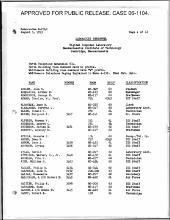
Laboratory Personnel
(MIT Digital Computer Laboratory, 1953-06-01)Memorandum listing Laboratory Personnel of the MIT Digital Computer Laboratory. -
Agenda for Central Stds. Committee Meeting, Friday, August 14, at MIT
(Lincoln Laboratory - Division 6, 1953-08-11)Memorandum on the agenda for a meeting of the Central Standards Committee on Friday, August 14, at MIT. -
Summary of MIT-IBM Collaboration on Design of AN/FSQ-7, Combat Information Central -- October 1 thru October 31, 1953
(Lincoln Laboratory - Division 6, 1953-10-09)Engineering work on AN/FSQ-7 equipment has included release of the pluggable unit design and concentrated activity in mechanical design, basic circuits, drum system design, the display system, and reduction of system tube ... -
Laboratory Personnel
(MIT Digital Computer Laboratory, 1953-08-03)Memorandum listing Laboratory Personnel of the MIT Digital Computer Laboratory. -
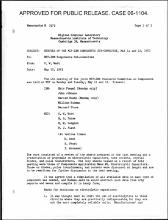
Minutes of the MIT-IBM Components Subcommittee, May 11 and 12, 1953
(MIT Digital Computer Laboratory, 1953-05-18)Minutes of a Joint MIT-IBM Components Subcommittee Meeting held at MIT on Monday and Tuesday, May 11 and 12. The work consisted of a review of the sheets prepared at the last meeting and a presentation of proposals on ... -
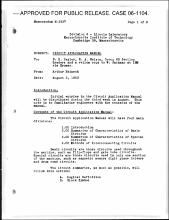
Activities of the Basic Circuit Sub-Committee
(Lincoln Laboratory - Division 6, 1953-08-03)Initial entries in the Circuit Application Manual will be distributed during the third week in August. This note is to familiarize engineers with the contents of the manual. -
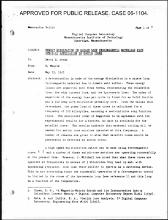
Energy Dissipation in Square Loop Ferromagnetic Materials with Specific Application to Switch Cores
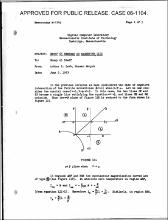
(MIT Digital Computer Laboratory, 1953-05-12)A determination is made of the energy dissipation in a square loop ferromagnetic material due to domain wall motion. These energy losses are separated into three terms, representing the relaxation loss. The order of magnitude ... -
IBM - MIT Memory Conference of 22 September 1953
(Lincoln Laboratory - Division 6, 1953-09-25)Joint IBM-MIT meetings were held at Project High on the 22nd of September to discuss the XD-1-2 internal memory. -
Group 61 Bi-weekly, March 28, 1952
(MIT Digital Computer Laboratory, 1952-03-28)Bi-weekly progress report of Group 61 research teams. -
Preparation of Technical Information for Components of Lincoln Transition System
(MIT Digital Computer Laboratory, 1953-05-19)Memorandum on preparation by Lincoln Laboratory to furnish information to AFCRC regarding technical engineering aspects of the equipment which will comprise the prototype models of the Lincoln Transition System. -
Ferrite Synthesis
(Lincoln Laboratory - Division 6, 1953-09-15)A systematic investigation of the MgO•MnO•Fe[subscript 2]O[subscript 3] system has indicated that rectangular hysteresis loops can be obtained over a wide range of composition. Maximum squareness is obtained in the region ... -
Bi-weekly Report, March 14, 1952
(MIT Digital Computer Laboratory, 1952-03-14)Bi-weekly progress report of Digital Computer Laboratory research teams. -
Planning, Scheduling and Administering the AN/FSQ-7 Program: MIT-IBM Communication (Supplement to M-2300)
(Lincoln Laboratory - Division 6, 1953-07-15)This memorandum outlines procedures for communication between MIT and IBM for work on the AN/FSQ-7 Program. -
Meeting on Preparation of Material for Colorado Springs 17 August Meeting
(MIT Digital Computer Laboratory, 1953-07-21)At a meeting on 21 July the following seven committees were created to prepare material for presentation to ADC for a meeting on 17 August. The final reports of the committees are due for editing and publication by 3 August ... -
A Linear Selection Magnetic Memory Using an Anti-coincident Current Switch
(MIT Digital Computer Laboratory, 1952-05-08)A linear selection memory in which each word is driven independently from a multi-position switch might have the following advantages over a coincident current memory: 1. No outputs from non-selected cores. ...